Areas we cover across London
We work from our workshop at 6 Atlas Road, Wembley HA9 0JH, across Greater London and the near Hertfordshire border.
Core coverage
Where most of our work is
Being based in Wembley means north, west and central London are on our doorstep. These are the areas we are in most weeks.
- Wembley
- Harrow
- Brent
- Ealing
- Camden
- Westminster
- Kensington & Chelsea
- Hammersmith & Fulham
- Barnet
- Islington
- City of London
- Watford
Full list
Every area we survey and install in
- Wembley
- Harrow
- Brent
- Ealing
- Acton
- Willesden
- Kilburn
- Camden
- Islington
- Westminster
- Marylebone
- Fitzrovia
- Mayfair
- Kensington
- Chelsea
- Hammersmith
- Fulham
- Chiswick
- Shepherd's Bush
- Notting Hill
- Maida Vale
- St John's Wood
- Hampstead
- Highgate
- Finchley
- Barnet
- Mill Hill
- Edgware
- Stanmore
- Pinner
- Northwood
- Ruislip
- Uxbridge
- Hayes
- Southall
- Greenford
- Wood Green
- Enfield
- Walthamstow
- Hackney
- Shoreditch
- City of London
- Clerkenwell
- Southwark
- Battersea
- Wandsworth
- Richmond
- Twickenham
- Kingston
- Watford
- Bushey
- Borehamwood
Not on the list? If you are within the M25 it is worth a call. We travel for larger projects and can usually fit a survey around work already booked nearby.
What we do across these areas
- Acoustic laminated glass
- Laminated safety glass: where it is required and where it is simply sensible
- Laminated glass cut to size: how it is cut and what to specify
- Laminated glass panels: choosing the right build-up
- Security laminated glass: the grades and where they are worth it
- Laminated glass for roofs, rooflights and overhead glazing
- Choosing a laminated glass supplier in London
London does not have one laminated glass problem, it has four, and they are not evenly distributed. Whether the right pane for you is acoustic, security, overhead or structural depends less on your postcode than on what is outside your window, but geography is a very good predictor. Below is how the work actually differs across the capital, and what changes about surveying, access and installation in each case. We cover Greater London from our Wembley workshop and are strongest in north, west and central London.
Noise: the rail and road corridors
The Victoria, Northern and Overground corridors produce the most acoustic enquiries we get, and they produce two different problems that need separating at the survey. Where a line runs on the surface or in a cutting, as the Overground does through Hackney, Kensal Rise, Brondesbury and Camden Road, and as the Northern line does out towards Finchley and Colindale, you have airborne noise arriving at the glass and acoustic laminated glass is genuinely the right purchase. Where the line is in tunnel beneath you, which is most of the Victoria line through Pimlico, Victoria, Stockwell and Brixton, what people usually notice is low frequency rumble and vibration coming up through the structure. No window helps with that, and we will say so in the first ten minutes rather than quote.
Road noise sorts the same way. Flats and houses fronting the A406 North Circular through Brent, Neasden, Palmers Green and Bounds Green, the A40 Western Avenue through Acton, Perivale and Greenford, Euston Road through Somers Town and Fitzrovia, and the South Circular through Catford, Dulwich and Mortlake all suffer from a mix of high frequency tyre and brake noise, which acoustic laminate handles well, and heavy lorry rumble, which is dominated by mass and will be reduced rather than removed. Honest expectation setting on those streets is more useful than a thicker pane. We also check the floor on ground-floor front rooms in terraces, because a suspended timber floor over airbricks delivers street noise into the room by a route that bypasses the window entirely.
Along these corridors the housing stock shapes the answer as much as the traffic. Victorian and Edwardian terraces in the inner boroughs have box sash windows whose hollow frame voids are themselves a sound path, so a new pane in an unrefurbished box does less than the data sheet suggests. Outer London 1930s semis in Harrow, Finchley, Ealing and Bromley usually have deeper reveals and better frames, and often already have double glazing, which means the sensible upgrade is an asymmetric acoustic unit in the existing openings rather than a whole-window job.
Heathrow flight paths: Hounslow, Isleworth, Richmond and Chiswick
Under the approach paths across Hounslow, Isleworth, Richmond and Chiswick the noise arrives from above, which changes the survey completely. Aircraft noise is broadband with plenty of mid and high frequency content, so acoustic laminated glass does measurable work on it, but in a house with a loft conversion, a rear rooflight or a glazed extension, the roof plane is often the weaker path than the windows. We look up as well as out in these boroughs. Where there is a rooflight over a bedroom or a lantern over a kitchen, upgrading those panes to an acoustic laminate frequently matters more than the front windows, and it doubles as the overhead retention the glazing needs anyway. Where a loft room has a plasterboard ceiling straight onto rafters with thin insulation above, we will tell you that the ceiling is the problem and that no glass we sell will fix it.
Security: ground floor and basement flats across the inner boroughs
Security laminated glass is overwhelmingly a Camden, Islington, Lambeth and Southwark product, and specifically a lower-ground and ground-floor flat product. The pattern repeats street after street: a lower-ground front room with its window sitting in a lightwell below pavement level and out of sight, a ground-floor rear patio door onto a shared or communal garden with easy access from a side alley, a sash whose original glass can be broken quietly with a gloved elbow. Those are the positions where a graded pane earns its money, because the attacker is screened from the street and has time.
The survey question we ask first is what the opening is fixed into. A BS EN 356 graded pane only performs if the frame, the beading and the fixings can hold it while it is being hit. Fitting a heavy security laminate into a tired timber sash with internal beads that lift with a screwdriver achieves very little, so in a lot of Victorian conversions the job is glass and frame work together, or glass plus proper restrictors and beading changes, rather than glass alone. We would rather scope that properly than sell you a pane and let you believe the opening is secure.
Where the property is a new conversion or a change of use, Approved Document Q brings security requirements for windows and doors into play and building control will want evidence against a recognised standard, so the class of glass needs to be stated and documented rather than described. The same applies when an insurer or a specifier refers to a police-preferred specification: those documents work by pointing at standards, so the useful answer is always a class and a test category. Across Camden and Islington we also deal with a lot of mansion blocks where the managing agent has a view on external appearance, and a laminated pane that looks identical to the original is usually easier to get approved than a visible grille or shutter.
Rooflights, glass extensions and glass floors: Clapham, Dulwich, Fulham and Crouch End
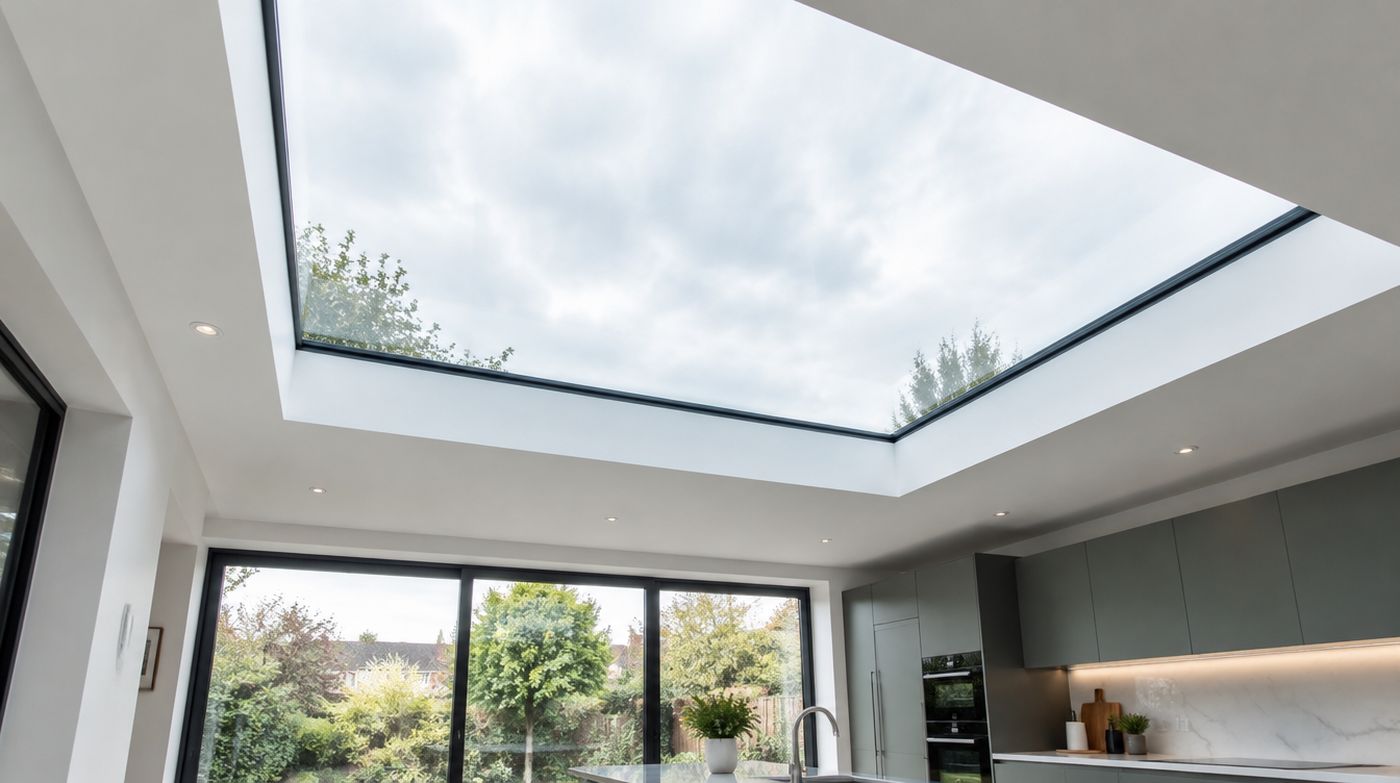
The side-return extension and the rear flat-roof rooflight are a south and west London institution, and in Clapham, Dulwich, Fulham and Crouch End we survey them constantly. Everything glazed overhead is judged on how it fails, which is why building control expects retention: a laminated lower leaf so that a broken pane sags and holds together rather than emptying itself into the kitchen. The same applies to lanterns, glazed links between a house and an outbuilding, canopies over side doors and basement pavement lights.
Glass floors and walk-on panels are a step up again. These are structural panes, usually multiple laminated leaves with a stiff ionoplast interlayer and a sacrificial top layer, designed so that losing the top sheet does not lose the floor. They are specified by calculation for the span and the imposed load, not chosen from a thickness list, and they are heavy enough that getting them into a Crouch End terrace or a Dulwich basement is a crane or a many-handed lift rather than a van delivery. We establish that at the survey, because the access plan can cost more than the glass.
In Crouch End, Highgate and parts of Dulwich there is an extra layer: conservation area control over what is visible from the street, which pushes extension glazing to the rear and affects the frames more than the glass. Worth checking before you design around a particular rooflight.
Conservation areas, listed buildings and the secondary glazing answer
Across Islington, Camden, Hackney, Richmond, Bedford Park in Chiswick, Dulwich Village and dozens of smaller designations, the original window has to stay, which rules out the simplest acoustic fix. The honest answer in most of these properties is acoustic secondary glazing with a laminated inner pane rather than a replacement unit, because the deep air gap between the original sash and the secondary unit does more for sound than any pane you can fit into a 19th century box sash. It is reversible, it does not need the planning argument, and it usually performs better. We say that even though it is not the sale we would choose.
Where secondary glazing is genuinely unacceptable, slim laminated units in refurbished sashes are possible, with the caution that the thickness the box will accept is limited and that putty rebates and shallow beads are exactly the conditions that let water sit against a laminated edge. Edge detailing and drainage have to be right in these windows or the pane will haze at the perimeter within a few years.
Weight, access and parking: the part most quotes ignore
Laminated glass weighs roughly 2.5kg per square metre for every millimetre of thickness, and because it is two sheets plus an interlayer it is always heavier than the single pane it replaces. A sash-sized 11.5mm laminate at 1.5m by 1.2m is about 52kg. A pair of large acoustic units for a double-fronted bay is a serious lift before anyone has reached the stairs.
That has real consequences across London. Mansion blocks in Maida Vale, Kilburn, Streatham and Marylebone often have lifts too small for a large pane, lift use restricted by the managing agent, or a goods-lift booking system that needs arranging a week in advance. Narrow Victorian terraces in Walthamstow, Peckham and Tooting frequently have no side access at all, so everything comes through the hall and up a dog-leg staircase with a tight quarter landing. Converted flats in Stoke Newington and Brixton tend to have the original staircase with a handrail that leaves less clear width than the pane needs. We measure the route, not just the opening, and if a pane will not go up the stairs we design the glass around the access rather than finding out on the day.
Parking is the other half of it. A glass van needs to stand close to the door, because carrying a 50kg pane two hundred metres is how people and glass get hurt. Across most inner boroughs that means a permit or a suspended bay arranged in advance, and in Camden, Islington, Lambeth, Southwark and Hackney the lead time for a suspension is not something to leave until the morning of the fit. Central jobs inside the congestion charge zone and controlled parking zones in Westminster and Kensington get planned around the restriction hours. We raise all of this at the survey and put it in the quotation, so nobody is standing on the pavement at 8am negotiating with a warden.
Why we survey before promising a noise improvement
The common thread across every part of London is that the window is one path among several. A Victorian terrace in Tooting, a 1930s semi in Harrow, a mansion block flat in Maida Vale and a new-build apartment in Nine Elms all leak sound differently, and the same acoustic laminated glass will perform very differently in each. New-build flats in particular are usually well sealed already, so the glass is often genuinely the weak point and an upgrade does what you hope. A draughty Victorian sash is the opposite case and needs the frame sorting first.
So we come and look, free of charge, anywhere in London. Then we tell you the order to spend your money in, give you a fixed written price for the part we think is worth doing, and let you decide. If the answer is that your problem is not a glass problem, you will hear that from us before you have spent anything.
Tell us what the glass has to solve
Noise, security, an overhead opening or a barrier. Describe the problem and we will specify the build-up and quote it in writing.