Choosing a laminated glass supplier in London
Most firms advertising as a laminated glass supplier in London do not laminate anything. Knowing which part of the chain you are buying from tells you your real lead time, your tolerance for changes, and who answers the phone when a size is wrong.
What a laminated glass supplier in London actually does
Four different businesses use the same words. Float glass manufacturers make the raw glass, and nobody in London buys from them directly. Laminators bond that glass to interlayers in an autoclave and sell it in sheet form. Processors cut, edge, drill, toughen and make up sealed units from those sheets. Glazing contractors survey, install and warrant the finished job.
Most companies that advertise as a laminated glass supplier in London are processors, merchants or installers. There is nothing dishonest about a merchant with a good van and a sharp price. But you should know whether the firm quoting will be cutting your glass or passing the order on, because that decides how a problem gets solved and how quickly.
We process in our own workshop in Wembley and fit with our own teams. That is a deliberate structure rather than a boast: it means one conversation when a size turns out wrong, and nobody between you and the person who cut the pane. How we work day to day is set out on the about page instead of repeated here.
Stock build-ups versus a special order laminate
This is the single most useful question to ask any supplier and almost nobody asks it: which of these build-ups do you hold, and which have to be made?
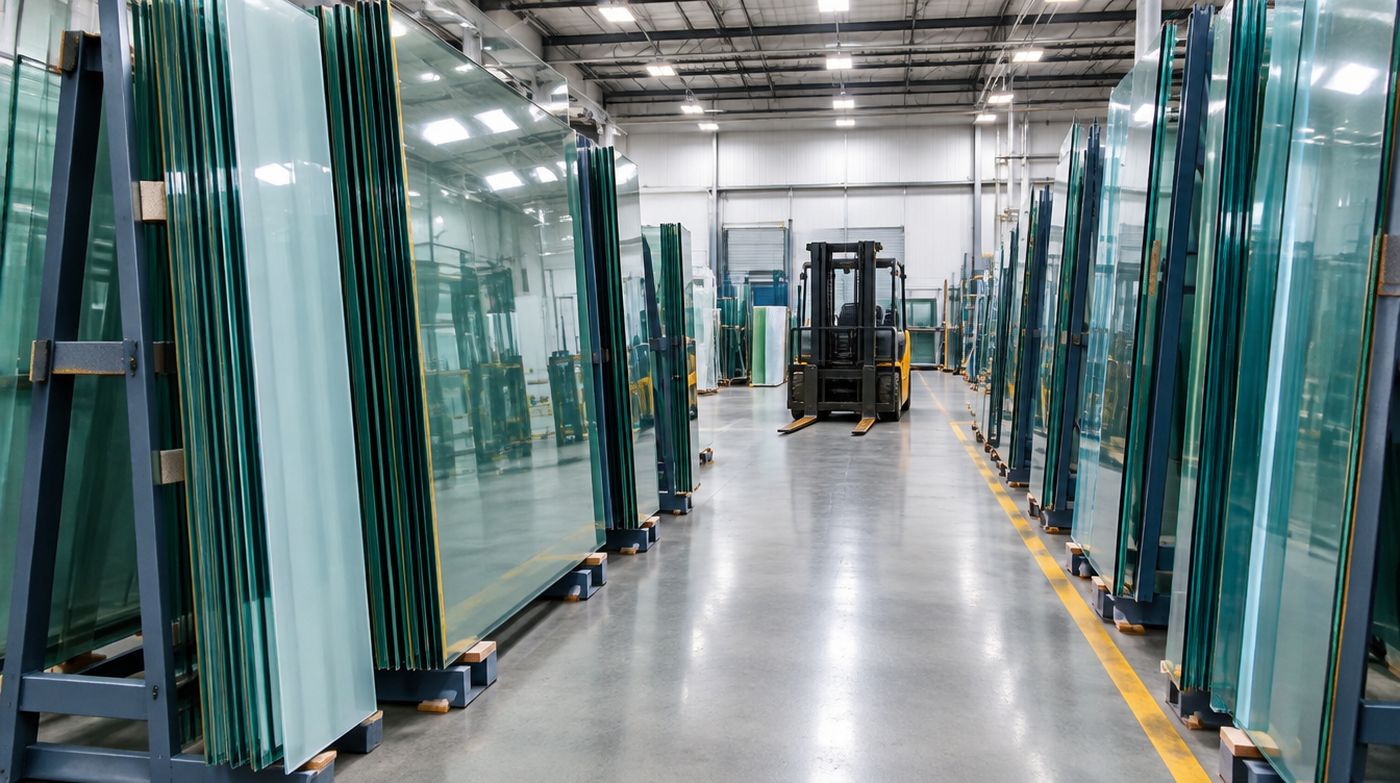
Clear laminated in the common thicknesses sits on racks. A supplier holding 6.4mm, 6.8mm, 8.8mm, 10.8mm, 11.5mm and 13.5mm clear can cut your sizes this week. Acoustic interlayers, security build-ups, coloured and solar control laminates, low iron and anything toughened before lamination have to be produced as sheets first, and that step is what turns days into weeks.
So when a supplier quotes a long lead time, find out which part of it is long. If the laminating is the constraint, chasing achieves nothing and you should plan around it. If their own cutting queue is the constraint, it is negotiable, and a polite question often moves an order up a day or two.
Processing capability is what you are really buying
Ask what happens inside their building and what leaves it. Every operation that goes to a third party adds days, adds a handling risk, and adds somebody who can blame somebody else when a pane arrives chipped.
For laminated work the operations that matter are straight cutting, shape cutting, arrissing, grinding, polishing, drilling and notching, toughening, heat soaking and sealed unit assembly. A firm that cuts and edges in house but sends toughening out is normal and entirely fine. A firm that sends everything out is a merchant with a van, and should be priced like one.
There is a second reason to care. Cutting laminated well is a hand skill, because the interlayer has to be parted cleanly after both glass leaves are broken. A workshop that does it daily produces a cleaner interlayer line and fewer flakes along the arris than one that does it occasionally. That edge is where delamination starts, so cut quality is not a cosmetic matter.
Lead times you should expect, honestly
Stock clear laminated, cut and arrissed, collected or delivered: a few working days. Polished edges add a day. Sealed units made up with a laminated leaf: usually one to two weeks depending on the spacer and the coating. Acoustic, security and toughened laminated build-ups: weeks, and in a busy spell more weeks than you would like.
Anybody promising a toughened laminated panel in two days either has that exact panel already on the floor or has not understood the order. Ask which, because the answer tells you a great deal about the rest of the quotation.
Delivery, damage and who carries the risk
Glass gets damaged between the rack and the frame, and the terms decide who pays for it. Ask when risk passes to you, whether you are expected to inspect panes before signing, and what happens to a pane that arrives with a chipped arris or a bruised edge.
Ask about the delivery itself as well. A supplier delivering to the kerb in a controlled parking zone will leave the glass at the kerb. Getting a 70 kilogram panel up two flights of a converted terrace is then your problem, your labour and your risk. Where we supply and fit, that question never arises, which is the quiet advantage of a single contract. Where we supply only, we say plainly which it is before you order.
The paperwork a supplier should hand over without being asked
Laminated glass is a construction product. It should come with a UKCA or CE mark and a Declaration of Performance referencing BS EN 14449, naming the build-up and the classifications it was tested against. For a safety pane that includes the impact classification. For a security pane it includes the BS EN 356 class. Where toughened glass forms part of the build-up overhead or in a barrier, you want confirmation of heat soaking too.
What ends up in your file should be simple: what was supplied, to which standard, in which class, by whom and when. If a supplier cannot produce that for a pane they sold you last year, you have learned something useful about how they keep records. What we keep and hand over is described on the about page.
How laminated glass is priced, and the charges to look for
Laminated glass is sold by area, but the area you are charged for is not always the area you receive. Most suppliers price off the cut rectangle that your pane comes out of, so an awkward shape or a long thin pane carries the waste around it. That is reasonable and standard, but it should be visible on the quotation rather than buried, and it is why two suppliers can quote very differently for the same shape.
Then look for the add-ons. A minimum pane charge, which makes small panes disproportionately expensive and is why you should order a set together rather than one at a time. A cut charge per pane. Edgework priced per metre. Delivery, and whether it is kerbside. Templating, if a shape or an out-of-square frame needs it. None of those are unfair, and a supplier who hides them all inside one round number is not being generous, just vague.
Trade and retail prices differ sharply in glass, more than in most trades, so if you are a builder or a joiner ordering regularly, ask about an account rather than paying the counter price every time.
Questions that separate a supplier from a reseller
- Which build-ups do you hold in stock, and which are made to order?
- What processing happens in your own workshop, and what goes out to somebody else?
- Will you put the build-up, the standard and the class on the quotation in writing?
- What tolerance do you work to on a cut size, and what clearance do you allow in the frame?
- Who is responsible if the pane is right and the frame turns out to be wrong?
- Can I have the Declaration of Performance for this glass?
When a cheaper laminated glass supplier is the right call
If you need twelve panes of 6.8mm clear laminated cut to size for a joiner to glaze, buy them from whoever is nearest and cheapest with a decent edge. There is no magic in clear stock laminated. It is a commodity, the standards are identical whoever makes it, and what you are buying is cutting accuracy and a van. We will quote it, and if a glass merchant round the corner from your site is cheaper, take their price.
What we would not buy on price alone is a security build-up, an overhead unit or a large barrier panel, because in those the specification, the calculation and the responsibility matter more than the cost of the glass. The difference between a good and a bad supplier only shows up when something is wrong, and those are the jobs where wrong is expensive.
What not to pay for
Polished edges on edges nobody will ever see. A thicker build-up with no stated reason behind it. Toughened laminated in a flat window pane. Self-cleaning coatings on glass that never gets direct rain. Express fees to shorten a lead time that is set by somebody else’s autoclave and cannot be shortened by paying. And survey fees: across London a survey for a glass order should be free, and ours is.
If a quotation contains a line you cannot explain back to yourself in one sentence, ask what it does. Good suppliers answer that question happily, because the answer is usually the reason they are worth using in the first place. Suppliers who get irritated by it are telling you something, and it is worth listening to.
FAQ
Questions about laminated glass supplier london
How do I choose a laminated glass supplier in London?
Establish what the firm actually does. Ask which build-ups they hold in stock and which have to be made, what processing happens in their own workshop and what goes out to a third party, and whether they will state the build-up, the standard and the class in writing on the quotation. Ask about the tolerance they cut to and who carries the risk if a pane is damaged in delivery. For stock clear laminated, price and proximity are reasonable grounds to decide. For security, overhead or barrier glass, capability and responsibility matter far more than the glass price.
Can I buy laminated glass without having it fitted?
Yes. Supply-only is a normal order: you give us the sizes or the opening dimensions, we cut from stock and edge the panes, and you collect from Wembley or take delivery. The two things to settle in advance are the measurements, because the tolerance and the clearance need to be agreed rather than assumed, and the delivery terms, because a kerbside drop leaves a heavy panel at the kerb and the risk with you from that point. For anything structural, overhead or security rated, it is worth discussing the frame as well, since the glass alone does not deliver the performance.
How long does laminated glass take to make?
It depends entirely on whether the build-up exists already. Clear laminated in common thicknesses is held in sheet form, so cutting and edging to your sizes is usually a few working days, with polished edges adding a day. Sealed units with a laminated leaf generally run one to two weeks. Anything that has to be laminated specially, which means acoustic interlayers, security build-ups, coloured or solar control laminates and toughened laminated panels, runs to several weeks because the sheet has to go through an autoclave before anybody can cut it.
Tell us what the glass has to solve
Noise, security, an overhead opening or a barrier. Describe the problem and we will specify the build-up and quote it in writing.