Laminated glass cut to size: how it is cut and what to specify
Laminated glass cut to size is the forgiving end of the glass trade, because unlike toughened it can still be cut after manufacture. This page covers how that is done, what we need from you, and where the process has limits.
Why laminated glass can be cut to size when toughened cannot
Toughened glass is heated above 600°C and chilled fast, so the surfaces end up in compression and the core in tension. Cut it, drill it or notch it afterwards and the whole pane detonates. Every dimension has to be settled before the furnace, which is why a toughened order is unforgiving and why a late change means a new pane and a new lead time.
Laminated glass is annealed glass bonded to a plastic interlayer. The glass carries no locked-in stress, so it can still be scored and broken in the ordinary way. That is what makes laminated glass cut to size the flexible option. We can take a stock sheet off the rack, cut it to your sizes the same week, and we can take two or three millimetres off an edge when a frame turns out not to be square.
The exception is toughened laminated, where both leaves are toughened before they are bonded. That cannot be cut, drilled or notched afterwards any more than a single toughened pane can. If your build-up has toughened in it, you are back to making every decision before manufacture.
How we cut laminated glass in the workshop
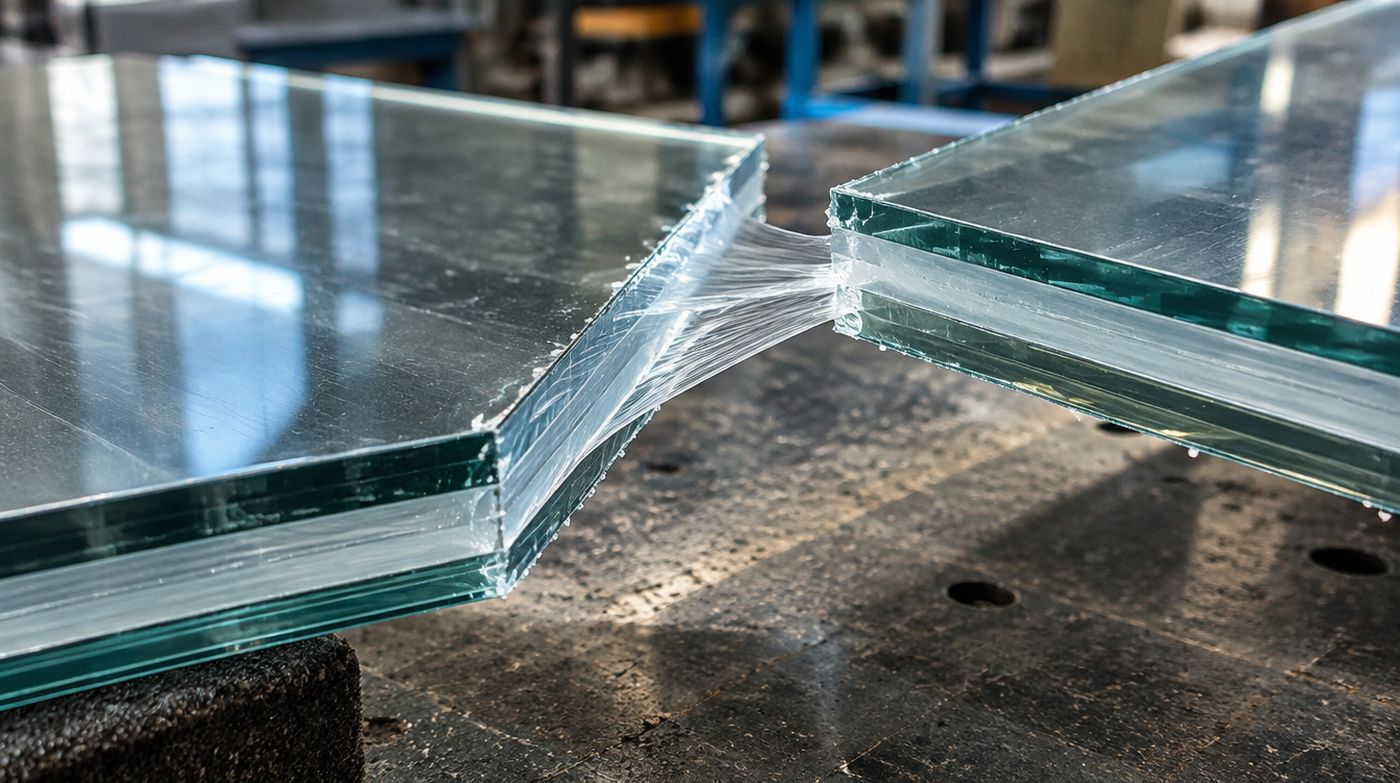
A laminated sheet is scored on both faces, with the two scores lined up precisely over each other. Both scores are then run, so each glass leaf breaks along the line and the sheet is left held together by the interlayer alone. The interlayer is parted either by drawing a blade through the opening or, better, by applying heat so the plastic softens and separates without leaving a ragged lip.
Done well the result is a straight edge with no feathering, no plastic standing proud of the glass and no pull-back where the interlayer has shrunk away from the leaves. Done badly you get a wavy interlayer line, small glass flakes along the arris and a pane that will give trouble at the edge for years. It is a hand skill. That is the main reason we cut in Wembley rather than buying panes in from a trade cutter and adding a margin.
Shapes, radius corners and notches are cut to a template or on the bridge, but the interlayer still has to be parted, and tight internal curves are where the process struggles. A 40mm radius corner on 6.8mm is routine. A 10mm internal notch in 11.5mm is a different conversation and sometimes the answer is that the detail has to change.
Measuring for laminated glass cut to size
For an order of laminated glass cut to size we want either the tight size of the daylight opening or the finished glass size you want made, clearly stated as one or the other. The difference between those two numbers is the clearance, and clearance is where almost every dispute about glass sizes begins.
Measure the width at three heights and the height at three widths, then give us all six figures rather than an average. Old London frames are rarely square. A Victorian sash box can easily be four or five millimetres narrower at the top than at the bottom, and a 1930s steel casement in a west London semi can be worse. Give us the rebate depth too, because that decides whether the build-up you want will sit in the frame with enough cover.
If a frame is visibly out of square or has a curved head, we would rather template it than take numbers over the phone. A hardboard template costs an hour of somebody’s time and saves a remake, and on a bay window with five lights it saves five.
Tolerances, and why a tight fit is the wrong target
Cut glass is made to a tolerance, not to a theoretical dimension. For laminated the tolerance is slightly wider than for single glass, because the two leaves can sit a fraction out of register and the interlayer is allowed to move during manufacture. On a domestic size, expect around a millimetre either way. On a large panel, expect more, and expect the edge of the interlayer to be trimmed rather than mirror-perfect.
So clearance is designed in deliberately. Glass that exactly fills an opening has nowhere to go when the frame moves, when the building settles, or when a timber sash takes up moisture through a wet February. Edge pressure is also one of the ways a laminated pane starts to delaminate. A pane sitting two or three millimetres under the opening on proper setting blocks will outlast a perfectly fitted one every time.
If a supplier promises an exact finished size with no tolerance stated anywhere, they are telling you something about their paperwork rather than about their cutting.
Edgework: what you need and what is decoration
Four options come up. A clean cut edge, which is sharp and perfectly fine hidden in a rebate. An arrissed edge, where the sharp corners are taken off, which is the minimum for anything that will be handled. A ground or satin edge, flat and matt, for exposed edges where appearance matters little. And a polished edge, bright and clear, for shelves, table tops, partition panes and anywhere an edge is on show.
If the edge is going into a frame you do not need it polished, and paying to polish four hidden edges is money burned. Arris is enough and we will quote it that way. Where we do push for more is on any edge you will touch, and on laminated in particular, where a polished edge closes the interlayer line neatly and looks far better than a ground edge ever will on a glass shelf.
One genuine difference with laminated: a polished edge shows the interlayer as a fine line. On clear PVB it is close to invisible. On an acoustic, coloured or structural interlayer it reads as a distinct stripe, and some people dislike that on a table top or an open shelf. Ask for a sample before committing on anything with exposed edges.
Delamination at a cut edge, which is the one real risk
The interlayer is a plastic, and water standing against an exposed edge for long enough will eventually creep in and cloud the bond. That is delamination. It starts at the edge, which means it starts where the glass was cut, and it shows as a milky band ten to twenty millimetres in from the perimeter.
You design it out with three things. Drainage, so the edge is never sitting in water. Compatible sealants and tapes, because some sealants attack PVB and the damage appears months later. And a frame that supports the pane on blocks instead of clamping its edge. Get those right and a cut laminated edge in a window will outlast the frame around it. Get them wrong in an exposed or overhead position and you will see the band within a few years.
This is why we ask what the pane is going into before we cut it, rather than simply taking the sizes and invoicing. A cut to size order for a dry internal shelf and one for an external canopy are not the same order even when the dimensions match.
Sizes, build-ups and what cutting cannot fix
We cut laminated glass to size from stock in the common build-ups: 6.4mm and 6.8mm for safety glazing and general replacement, 8.8mm and 10.8mm where span or wind load increases, 11.5mm and 13.5mm for heavier panels and acoustic work. Thicker laminates, security build-ups and special interlayers come in as sheets and are cut to your sizes once they arrive.
The maximum size of a cut pane is limited by the sheet, by the weight and by what can be handled safely, not by the cutting. A 2500 by 1500 pane in 11.5mm weighs around 105 kilograms, which is a hoist or four people with suckers and a clear route. The access route often decides the panel size long before the glass does.
Cutting cannot repair a decision made upstream. Holes, cut-outs for hinges or patch fittings, and toughened laminated build-ups are all manufacture decisions, and no amount of workshop work afterwards will add them. And if you are ordering replacement panes for a whole house, order one, fit it, and then order the rest. It is the cheapest insurance in glazing and it costs you two days.
Lead times on laminated glass cut to size
Clear laminated from stock, cut and arrissed, is usually a few working days. Polished edges add a day. Acoustic build-ups, security laminates, coloured and solar control interlayers and anything toughened before lamination run to weeks, because the sheet has to be made in an autoclave before anybody can cut it. We will tell you which category your order falls into before you commit, and where a stock build-up will do the same job as the special one, we will tell you that too and lose the extra margin.
FAQ
Questions about laminated glass cut to size
How is laminated glass cut without damaging the interlayer?
The sheet is scored on both faces, with the two score lines aligned over each other, and both scores are then run so each glass leaf breaks cleanly along the line. At that point the sheet is held together only by the interlayer, which is parted either with a blade or, better, by applying heat so the plastic softens and separates without leaving a ragged lip. Heat gives the cleaner result, with no feathering and no plastic standing proud of the glass. It is a hand skill, and the quality of that edge matters because delamination, when it happens, starts at the edge.
What tolerance should I allow when ordering laminated glass cut to size?
Allow clearance deliberately rather than ordering a pane that exactly fills the opening. Cut glass is made to a tolerance of roughly a millimetre either way on domestic sizes, and laminated is slightly wider than single glass because the two leaves can sit marginally out of register. Beyond that, a pane with no clearance has nowhere to move when the frame expands or the building settles, and edge pressure is one of the ways a laminated pane begins to delaminate. Two or three millimetres under the tight opening size, sat on proper setting blocks, is the sensible target.
Can toughened laminated glass be cut to size?
No. In a toughened laminated build-up both glass leaves are toughened before they are bonded together, and toughened glass cannot be cut, drilled or notched after manufacture without the pane breaking. Every dimension, every hole and every notch has to be fixed before it goes into the furnace. That matters for barriers, overhead glazing and anything else where toughened laminated is specified, because a measurement error means a new panel and a new lead time rather than a quick trim. Ordinary annealed laminated glass, which covers most safety glazing, can be cut to size normally.
Tell us what the glass has to solve
Noise, security, an overhead opening or a barrier. Describe the problem and we will specify the build-up and quote it in writing.